Habits
Fringe or no fringe: the decision, made properly

Every woman with receding corners has stood in front of a mirror holding a section of hair across her forehead, wondering. The answer is more specific than yes or no, and it depends on where the thinning is, what your hair does, and how much time you have at seven in the morning.
What a fringe does for thinning
It covers the front hairline entirely, which removes the corners from view. Because the hair in a fringe is cut short, it stands away from the head rather than lying flat, which reads as thickness. And it takes the weight out of the front section, so the hair behind it lifts at the root and the front of the parting closes up. For temple recession and a wide parting at the front, it is the single most effective cosmetic change available, and it is reversible.
The kinds, and what each suits
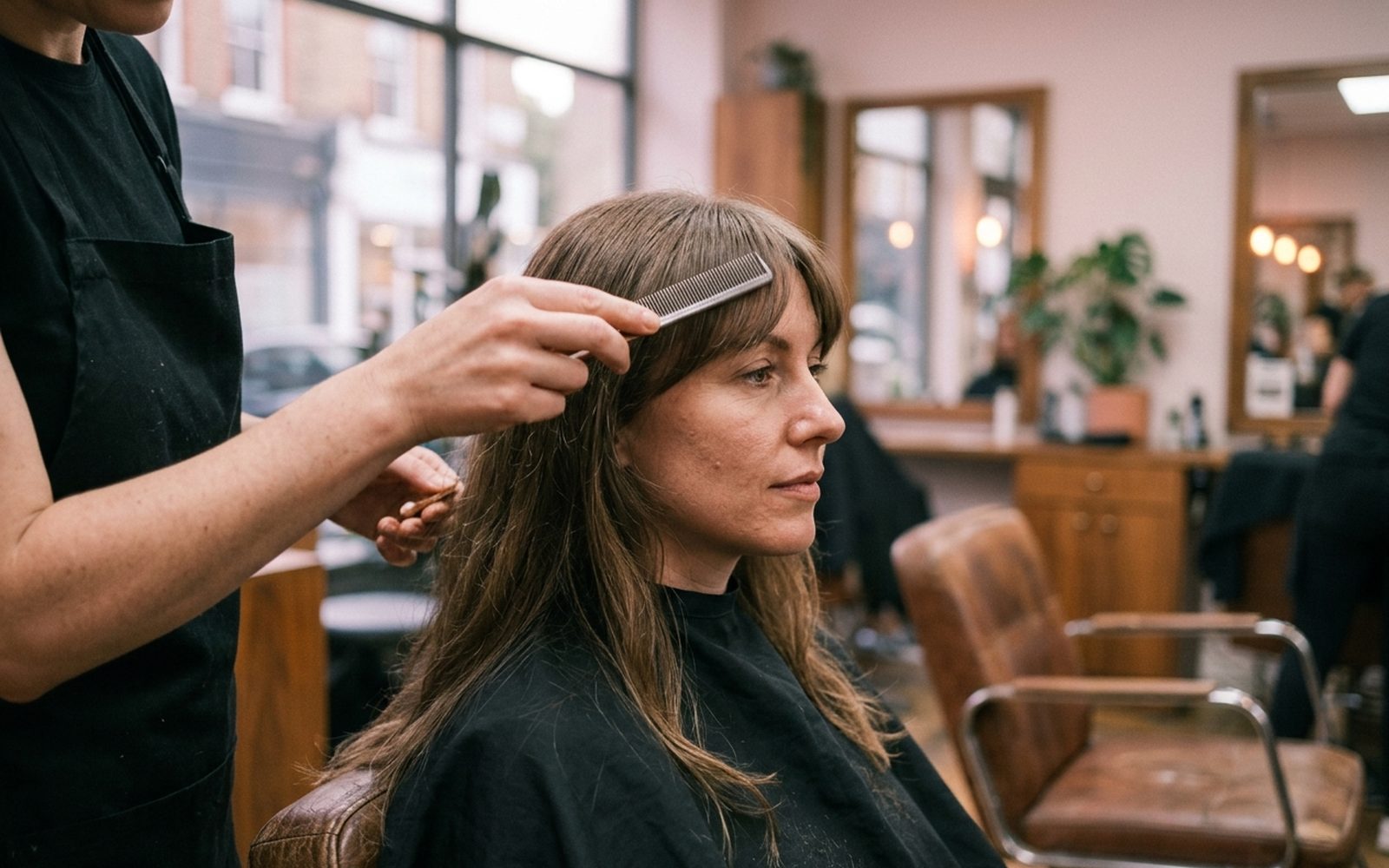
Curtain fringe. Parted in the middle, swept to either side, longest at the outer edges. Covers the temples completely while leaving the centre of the forehead open. Grows out gracefully. The best option for receding corners, and the most forgiving for fine hair because it is not trying to be a solid block.
Soft full fringe. Straight across, cut with a little softness at the ends, sitting at or just below the brows. Covers everything, including a thin front parting. Needs enough density at the front of the crown to draw from — on very thin hair a full fringe can look see-through and expose the scalp behind it, which is worse than no fringe. Needs trimming every four to five weeks.
Not sure which one is you?
Take the two-minute hair quiz
Twelve quick questions. We tell you what we think is going on, what to do about it, and we say so if it is something we cannot help with.
Start the quiz →Side-swept fringe. A long fringe swept across to one side. Covers one temple well and the other less; suits a woman whose thinning is asymmetric or who parts to the side anyway. The easiest to grow out and the easiest to pin back.
Wispy or micro fringes. Fashion, not disguise. On thinning hair they show scalp. Avoid.
Who should not
A woman with a very fine front section and a low hairline: a fringe will look sparse and there is not enough to make it from. A woman with a strong cowlick at the front: it will not lie down without heat every morning, and heat is what we are trying to reduce. A woman with an oily scalp who cannot wash every other day: a fringe on the forehead goes greasy by lunchtime. And a woman who knows herself well enough to know she will pin it back within a fortnight.
Trial it without cutting
Clip-in fringes are cheap and, from a good supplier, convincing. Wear one for a week — through a school run, a work day, a wash day — and you will know. If you buy one, match the colour to your roots rather than your lengths.
Looking after it
Wash the fringe alone at the sink on days you do not wash the rest; it takes two minutes and solves the grease problem. Dry it first, straight away, with the dryer on medium, brushing it side to side so it does not split in the middle. No dry shampoo on the forehead skin. A fringe trim between full cuts is usually free or nearly so at most salons.
What it cannot do
Change what the follicles underneath are doing. A fringe hides recession; it does not slow it, and a woman who cuts a fringe at 38 and does nothing else will usually find it needs to be heavier at 42. It is the best cover there is, and it buys time; the time is for finding the cause. This article is where to start.
Ready to read your own pattern?
Take the two-minute hair quiz
Twelve questions. We tell you what we think is going on for you, and we say so if it is something a GP should see first.
Start the quiz →