Habits
Is the mum bun making it worse?

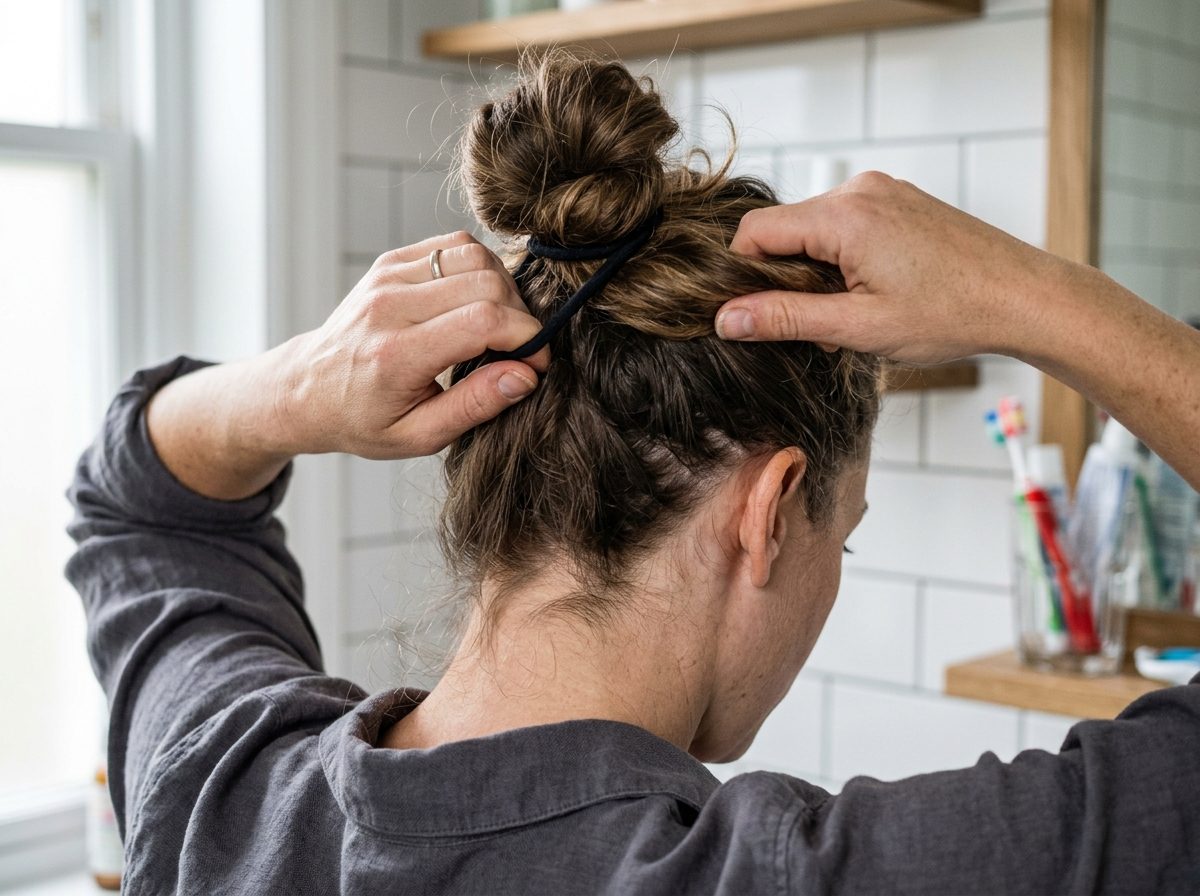
It is the most common question I get from mums, usually asked with a slightly guilty look: is it the bun? The honest answer is: partly, sometimes, and almost never on its own.
What traction does
Constant tension on the hairline — a tight bun or ponytail worn most days for years — causes traction alopecia. It shows as thinning and short broken hairs exactly where the pull is greatest: the front hairline and the temples, and sometimes around the ears. It is mechanical, it is gradual, and in the early stages it is reversible simply by taking the tension off.
Why it is rarely the whole story
Traction thins the hairline. It does not widen the parting, thin the ponytail, or fill the plughole. If you have any of those alongside the temples, the bun is at most a contributor. And the mums who blame the bun are usually the ones whose hairline was already becoming DHT-sensitive after children; the tension simply made the weakest follicles give up first.
What to actually change
- Lower and looser. A low ponytail with a soft fabric bobble puts a fraction of the tension on the hairline that a high tight bun does.
- Move it. Alternate the position through the week so no one section carries the load every day.
- Down at home. The hairline needs hours a day with no pull at all. Evenings and weekends count.
- Stop the scraped-back wet bun. Wet hair stretches; tying it tight while wet is the single most damaging version of the habit.
What not to expect
Taking the tension off stops the mechanical damage. It does not restart follicles that have gone quiet for hormonal reasons, and it does not thicken the hair that came back finer after children. If six to eight weeks of looser styling changes nothing at the corners, the cause is not the bun — and the pattern will tell you what it is.
Not sure which one is you?
Take the two-minute hair quiz
Twelve quick questions. We tell you what we think is going on, what to do about it, and we say so if it is something we cannot help with.
Start the quiz →Ready to read your own pattern?
Take the two-minute hair quiz
Twelve questions. We tell you what we think is going on for you, and we say so if it is something a GP should see first.
Start the quiz →